
Your Diesel Drivetrain Is Talking. Are You Listening?
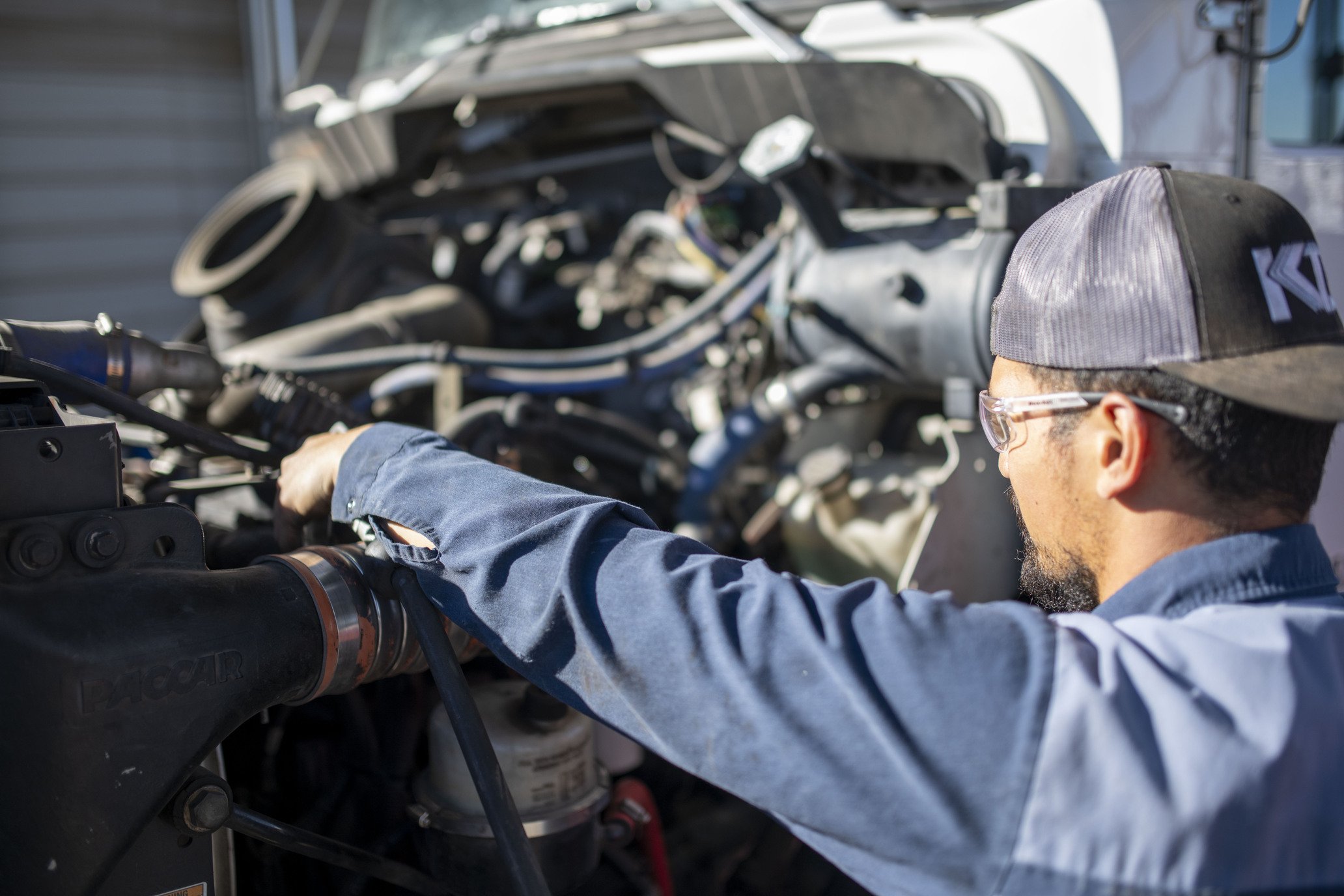
How to Catch Drivetrain Problems Before They Kill Your Schedule
By KTS Enterprise | Fleet Maintenance Experts in Phoenix & Chandler, AZ
There's a moment every fleet manager dreads: a driver calls in at 6 AM. The truck won't move. It rolled fine yesterday. Today it's a $40,000 anchor sitting in someone's parking lot.
More often than not, that truck had been trying to tell you something for weeks. The problem wasn't sudden. It was ignored.
The drivetrain is one of the hardest-working systems on a commercial diesel vehicle. Every mile, it transfers enormous torque from the engine through the transmission, driveshaft, differentials, and axles to the wheels. When any one of those links degrades, the whole chain pays the price. And when it finally fails, you're not looking at a minor repair. You're looking at major downtime, a tow bill, and a job that didn't get done.
Here's what your drivetrain has been trying to tell you, and how to make sure you're listening.
The Drivetrain: What It Actually Does
Before you can spot a problem, it helps to understand what you're dealing with. The drivetrain on a Class 6-8 diesel truck is a chain of components that converts engine power into forward motion:
Transmission: Shifts power across gear ratios to match load and speed demands
Driveshaft(s): The rotating shaft(s) that carry torque from the transmission to the rear axle(s)
U-Joints (Universal Joints): The flex points that allow the driveshaft to move with the suspension
Differentials: Split torque between drive wheels while allowing them to rotate at different speeds
Axle Shafts: Transfer torque from the differential out to the wheels
Every one of these components wears over time. The question is whether you catch that wear on your terms, during a scheduled service, or on the road's terms at the worst possible moment.
5 Drivetrain Warning Signs Fleet Drivers Should Report Immediately
The most valuable diagnostic tool you have isn't a scanner. It's your driver. Train your drivers to recognize and report these symptoms the moment they appear.
1. Vibration at Highway Speeds
A vibration that starts around 50-65 mph and intensifies with speed is one of the most common early signs of driveshaft trouble. It often points to a worn or failed U-joint, an out-of-balance driveshaft, or a driveshaft that's shifted out of phase due to a loose yoke or center bearing.
Many drivers write this off as a rough road. Don't let them. A vibrating driveshaft doesn't stay vibrating. It progresses to a catastrophic separation, which can damage the frame, fuel lines, and anything else in its path.
2. Clunking or Knocking During Gear Changes
A hard clunk when shifting from park to drive, or when the truck accelerates from a stop, is a classic symptom of worn U-joints or excessive driveshaft slip yoke play. Under light load, it hides. Under torque, it announces itself loudly.
This symptom is easy to dismiss as "just how the truck shifts." It shouldn't be dismissed. By the time the clunk becomes constant, joint wear is typically severe.
3. Differential Whine Under Load
A high-pitched whine or grinding noise coming from the rear axle area, particularly when the truck is loaded and climbing a grade, is often a sign of worn ring and pinion gears or low differential fluid. Differential fluid breaks down over time, loses its viscosity, and stops protecting the gear faces properly.
Left unaddressed, differential wear accelerates quickly. What starts as a fluid change becomes a ring and pinion replacement, and then a full axle rebuild.
4. Binding, Shudder, or Hesitation on Turns
If your driver notices that the truck feels "tight" or shudders when turning, particularly on a loaded delivery route with lots of dock maneuvering, the culprit is often a worn or seized differential. Inter-axle differentials on tandem-axle trucks are especially susceptible to this when the diff-lock is engaged or disengaged improperly over time.
5. Transmission Slipping or Delayed Engagement
When the truck revs normally but the power doesn't translate to the wheels, or there's a noticeable lag between shifting and forward movement, the transmission itself is showing wear. In automatics, this often points to low or degraded transmission fluid, a slipping clutch pack, or solenoid issues. In manuals, clutch slippage is the more common culprit.
Either way, this is not a "monitor it" situation. A slipping transmission under full load can fail completely with very little additional warning.
The Hidden Drivetrain Killer: Deferred Fluid Services
If there's one thing that accelerates drivetrain wear faster than mileage, it's neglected fluid maintenance. Transmission fluid, differential fluid, and transfer case fluid all have service intervals, and in the Arizona heat, those intervals matter more than they do anywhere else.
Operating temperatures in the Phoenix metro regularly push diesel drivetrains to their thermal limits. Fluid that might last 60,000 miles in a moderate climate breaks down at 35,000-40,000 miles here. When the fluid degrades, metal-on-metal contact increases, and wear that should take years happens in months.
At KTS Enterprise, drivetrain fluid services are part of every preventative maintenance plan we build for Arizona fleets. It's not an upsell. It's the single most cost-effective thing you can do to extend drivetrain life.
What a Proper Drivetrain Inspection Looks Like
A visual check during a pre-trip inspection is valuable but limited. A thorough drivetrain inspection, the kind that catches problems before they become failures, includes:
U-joint inspection for play, corrosion, and grease cap integrity: U-joints should have zero perceptible play when the driveshaft is twisted by hand
Driveshaft runout measurement: Checked with a dial indicator to detect bending, damage, or out-of-balance conditions
Center bearing inspection: The rubber isolator in the center support bearing degrades over time and allows the driveshaft to sag and vibrate
Differential fluid analysis: Pulling a sample and checking for metal particles, water contamination, or discoloration
Axle seal inspection: Leaking axle seals let fluid out and let contaminants in; they're a reliable early indicator of bearing wear
Transmission fluid level and condition check: Color, smell, and viscosity all tell a story
This is exactly what our technicians cover during in-shop fleet service visits. We document everything and flag what needs immediate attention versus what can be monitored, so you can make informed decisions instead of reactive ones.
The Real Cost of Waiting
Here's a number worth keeping in mind: the average unplanned roadside breakdown for a Class 8 truck costs between $3,000 and $5,000 when you factor in towing, emergency repair rates, driver downtime, and missed delivery penalties. That's before you account for a customer relationship that got damaged because a load didn't show up.
A U-joint replacement caught during a PM service? Roughly $300-$600 in parts and labor.
A driveshaft that separates on I-10 because that U-joint was ignored? You're looking at frame damage, fuel line inspection, towing, emergency shop rates, and a truck that's out of service for days.
The math isn't complicated. The hard part is building a maintenance culture that acts on what the truck is telling you, rather than waiting until it stops talking and starts breaking.
What to Do Right Now
If any of the warning signs above sound familiar, or if you honestly can't remember the last time your fleet's differentials and driveshafts were inspected, it's time to schedule an in-shop service.
At KTS Enterprise, we work with fleet managers across the Phoenix and Chandler area to build maintenance programs that catch drivetrain problems early, document everything, and keep your trucks on the road where they belong.
Call us at (602) 878-6088 or schedule online at ktsdiesel.com.
Your drivetrain is talking. Let's make sure you don't miss the message.